Friday, February 7, 2014

Parameters to consider in running a biogas digester

The parameters are: 
  1. Acidity - Anaerobic digestion will occur best within a pH range of 6.8 to 8.0.
  2. Carbon-nitrogen ration (C/N) - a carbon - nitrogen ratio of about 30 - 1 is ideal for the raw material fed into a biogas plant.
  3. Temperature control - A temperature between 32°C and 35°C has proven most efficient for stable and continuous production of methane. but the action of the digesting bacteria will decrease sharply below 16°C.
  4. Percentage of solids - Anaerobic digestion of organics will proceed best if the input material consists of roughly 8 % solids. In the case of fresh cow manure, this is the equivalent of dilution with roughly an equal quantity of water.
  5. Plant design - above or below ground. There are pros and cons with either types.
  6. Continuous/batch operation - there are pros and cons with either types.
  7. Stirring - stirring the slurry in a digester is always advantageous, if not essential.
  8. Gas collection - A non-return valve here is a valuable investment to prevent air being drawn into the digester, which would destroy the activity of the bacteria and provide a potentially explosive mixture inside the drum.
  9. The level of carbon dioxide and proportion of methane will give valuable information about the state of the fermentation process as well. Infrared sensors are the best means employed today for this purpose. The need for calibration is minimal or nonexistent and the small size, relatively low cost and minimal power consumption make them ideal for this type of application.
More info: http://www.habmigern2003.info/biogas/methane-digester.html
 

Construction of a Hestia biogas digester

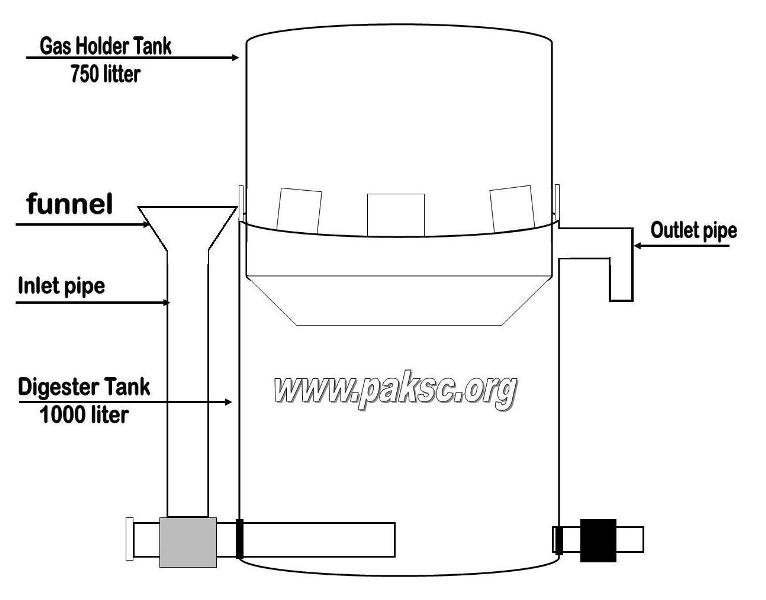
A general rule is that the tank needs to be 50 times the size of the daily input to allow for some space for gas to collect. If your input is 15 gallons of material per day, you’d need a 750-gallon tank.

Hestia biodigesters are approximately 5 by 7 feet wide by 5 feet deep, providing about 700 gallons of capacity. Slurry occupies about 600 gallons of this biodigester; the remaining space is for the gas that’s produced.

There’s an inlet for adding feedstock and an outlet for removing composted slurry.

A closed loop of PEX tubing in the bottom of the tank is plumbed to an on-demand water heater to add heat when the slurry temperature drops below 50°F—the temperature at which cryophilic methanogenic bacteria go dormant and stop producing gas.

If the climate is mild, it may be enough to build a hoop house over the tank to keep the slurry sufficiently warm in winter. Alternatively, the biodigester could be allowed to go dormant during the colder months.


More info: http://energez.blogspot.com/2012/04/video-hestia-home-biogas-plant.html

Need Biogas Now?
Search This Blog